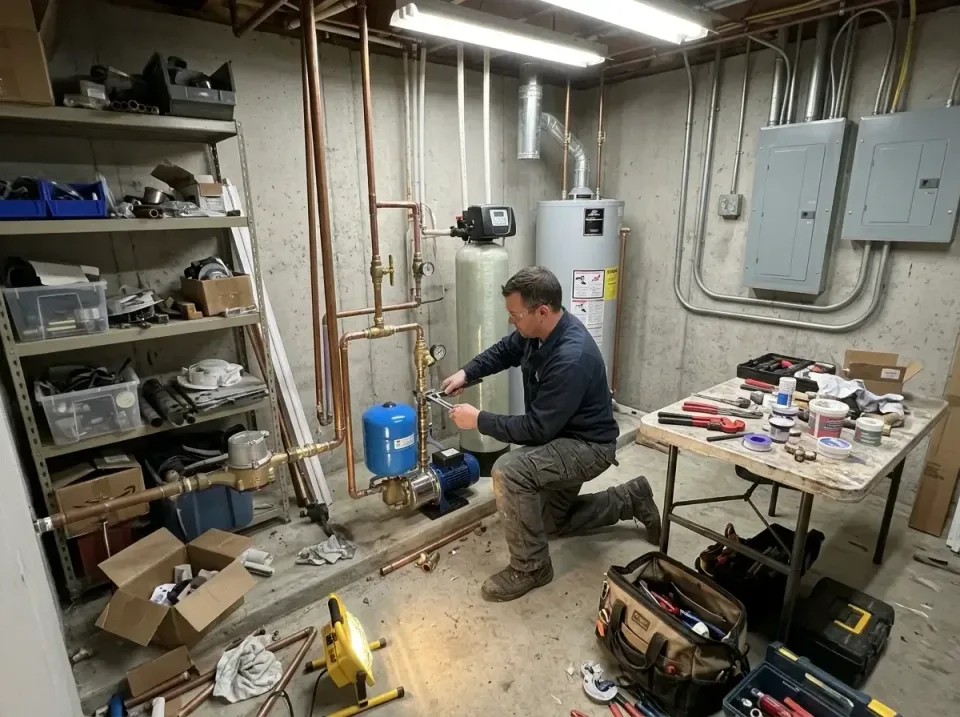
Water Pressure Diagnosis
Water Pressure Diagnosis checks residential pressure at fixtures and hose bibs; a typical visit runs $125–$275, depending on access and testing scope.
A booster pump can steady a fluctuating shower only when the supply pressure or flow is genuinely too low; it cannot clear a blockage or repair a failing valve. If pressure falls throughout the home, testing should come before pump selection.
Severe storms can interrupt municipal service or cut power to booster equipment, so a pump is not a backup water supply. Cold winters also put exposed plumbing at risk: a frozen section can restrict flow, and adding pump force will not safely thaw it.
Check the pattern: Note whether other faucets weaken when the shower runs.
Compare hot and cold: A hot-side-only problem points toward a different restriction than a whole-house drop.
Watch for a storm link: Record whether the change follows a service interruption or power outage.
Consider freezing: Check accessible pipes for cold exposure, but do not use a pump to push through a suspected freeze.
Write down when the pressure changes before arranging a pressure diagnosis.
A shower that weakens whenever another tap runs may benefit from a booster, but only after a pressure and flow test confirms the incoming supply cannot keep up. Static pressure describes a reading when water is not moving; dynamic pressure shows what remains while fixtures draw water.
That distinction matters. A gauge reading alone can look acceptable even as a restricted line starves the shower under demand.
We compare readings at more than one fixture and check whether the problem affects the whole house or just one branch. A test does.
A failing pressure-reducing valve, partially closed shutoff, leak, clogged line, or worn fixture can imitate a supply problem. If only the hot side falters, a booster on the main may not address the cause.
If multiple fixtures dip together, the issue may be upstream or related to the building’s piping. We look for the point where pressure changes rather than treating every weak shower as a pump problem.
Private wells need a different check. Drought periods can strain well supplies, so pumping harder may not restore a reliable source and could aggravate cycling.
At homes near Matthiessen State Park in Oglesby, well owners should note whether pressure changes track water use or persist even after demand stops. That pattern helps separate supply limits from equipment trouble.
The well pump cycling guide explains another symptom to watch for.
A pump must match the home’s actual demand and supply conditions. Too little capacity may leave the shower weak; too much can create excessive pressure, noise, or stress on piping and fixtures. We check pressure while water is flowing, then consider how many fixtures may operate at once and where the pressure loss occurs. Pump selection is not based on the showerhead alone.
The booster pump installation process should follow a diagnosis that rules out a restriction or faulty valve first. A property near Morton Arboretum in Lisle may have a different layout and demand pattern than a compact home; the pump still has to be matched to measured conditions, not a neighborhood assumption. We explain the findings before recommending equipment.
You can clean a showerhead or confirm that an accessible shutoff is fully open. Stop there if pressure drops across several fixtures, a pump cycles repeatedly, a leak is suspected, or electrical work is involved. Booster equipment combines water and electricity, and an incorrect installation can introduce new faults rather than solve the original one.
A useful next step is to record which fixtures are running when the shower weakens. We can then compare pressure and flow, inspect accessible components, and explain whether repair or a pump is warranted.
If the symptoms began suddenly, the whole-house pressure drop guide offers a practical checklist to help describe what changed. Near the Abraham Lincoln Presidential Library and Museum in Springfield, as elsewhere in Illinois, the diagnosis should lead the recommendation not the other way around.
The right fix depends on whether the trouble is low supply, a restriction, or equipment that cannot maintain pressure under demand. A pump is only one option.
| Option | Best for | Key detail |
|---|---|---|
| Booster pump | Supply that tests too low under demand | Residential pressure commonly falls within 40–80 psi; size for demand and lift |
| Pressure-reducing valve repair | Excessive or unstable incoming pressure | A regulator reduces pressure; a pump raises it |
| Clogged-line repair | Multiple fixtures affected downstream | A common main is 3/4-inch to 1-inch; restrictions reduce flow |
| Well tank repair | Well system with unstable cycling | Tank capacity commonly ranges 20–80 gallons |
Freeze-thaw cycles can stress buried water lines, so a pressure drop may call for line inspection rather than pump installation. Lakefront homes near Lincoln Park may also face lake-effect snow that complicates outdoor access to a service line. If your home is near Allerton Park and Retreat Center in Monticello or Anderson Japanese Gardens in Rockford, the same test-first approach applies: identify the fault before choosing equipment.
A clear symptom record helps us distinguish an undersized supply from a fixture or piping problem. Before testing, leave access to the meter, regulator, and utility-room equipment; a home near Brookfield Zoo may have a different service layout than one near the Frank Lloyd Wright Home and Studio, so identify the actual access points rather than assuming their locations.
Record symptoms: Note which shower and other fixtures lose pressure, and whether the change occurs during simultaneous use.
Clear access: Move stored items away from the meter, regulator, basement, or utility-room work area.
Find the shutoff: Identify the main shutoff before pressure testing; do not operate a stuck valve by force.
Prepare the work area: Protect nearby floors and cabinets, and arrange household water shutoff timing with occupants.
Identify equipment: If the property has a well, point out the tank and pump locations before service begins.
Confirm the result: Ask for pressure checks before and after adjustments and confirmation that the shower holds steady.
Traffic or access planning near the Champaign-Urbana Mass Transit District may affect when occupants can be present, so agree on a workable appointment window. A visit near Gateway Arch National Park is outside Illinois service geography; do not use that landmark to infer local coverage or a route.
No, not by itself; seasonal temperature swings can change pipe dimensions and aggravate an existing weak point, but a pump does not repair damaged or restricted piping. Have the pressure and affected line checked before adding equipment, especially if the change appears across several fixtures.
Booster pump installation is commonly estimated at $800–$2,500, with pump capacity and electrical work affecting the scope. A pressure diagnosis may cost $100–$300 depending on testing and access, so confirm the cause before approving a pump.
Yes, contact a plumber if the pressure loss affects several fixtures, a pipe may be frozen, or a leak appears; do not use a booster to force water through a suspected freeze. Snow and ice can delay service access and repairs, so protect exposed plumbing safely and report the affected locations when booking.
Yes, plumbing work must be evaluated under applicable requirements, including the Illinois Plumbing Code, 77 Ill. Admin. Code 890.
Possibly; a pressure-reducing valve that is faulty or incorrectly set can affect pressure, and a pump will not correct every regulator problem.
A booster pump may stop shower fluctuations when testing confirms the supply cannot maintain pressure under normal demand. It will not fix a clogged line, leaking pipe, or defective regulator, so diagnosis comes first.
We test at multiple fixtures, explain what the readings show, and discuss the repair options before work begins. If your shower fades when other fixtures run or pressure drops without warning, contact Illinois Plumbing Pros to arrange water pressure diagnosis and review the next step.
No, not by itself; seasonal temperature swings can change pipe dimensions and aggravate an existing weak point, but a pump does not repair damaged or restricted piping. Have the pressure and affected line checked before adding equipment, especially if the change appears across several fixtures.
Booster pump installation is commonly estimated at $800–$2,500, with pump capacity and electrical work affecting the scope. A pressure diagnosis may cost $100–$300 depending on testing and access, so confirm the cause before approving a pump.
Yes, contact a plumber if the pressure loss affects several fixtures, a pipe may be frozen, or a leak appears; do not use a booster to force water through a suspected freeze. Snow and ice can delay service access and repairs, so protect exposed plumbing safely and report the affected locations when booking.
Yes, plumbing work must be evaluated under applicable requirements, including the Illinois Plumbing Code, 77 Ill. Admin. Code 890.
Possibly; a pressure-reducing valve that is faulty or incorrectly set can affect pressure, and a pump will not correct every regulator problem.
Browse all nationwide service options and choose the right fit for your project.
Water Pressure Diagnosis checks residential pressure at fixtures and hose bibs; a typical visit runs $125–$275, depending on access and testing scope.
We install home booster pumps sized to demand; capacity and electrical work shape the typical $800–$2,500 range. Wind chill can freeze exposed piping, so Springfield and Decatur access matters.
We trace sudden whole-house pressure drops for Illinois homeowners, checking accessible supply lines and pressure controls; typical repair costs depend on the failed part and access, often $150–$1,200.
We locate and repair pressure-affecting water line leaks for homeowners, including accessible pipe and buried-line work; typical repairs run $250–$1,500, depending on location and excavation.
We repair residential pressure-reducing valves, including accessible valve and connection work; typical repairs run $200–$600, depending on parts and labor.
We clear residential water-line blockages and inspect accessible pipe sections; a typical visit may run $200–$800, depending on access and blockage severity.
We repair showerheads, valves, and pressure problems; typical repairs run $150–$600 depending on access and parts. Illinois seasons and lake-effect snow can affect service timing.
We repair residential water booster pumps, checking pump components and controls; typical repairs may run $150–$600, depending on parts and access.
Well Water Pressure Repair addresses weak flow and cycling pumps by checking well controls, tank settings, and piping. Cost depends on the fault, parts, and access.
We clear or replace restricted faucet aerators and worn fixture parts; typical repairs run $125–$350, depending on access and parts.
We repair or replace well pressure tanks, matching tank capacity and piping; replacement commonly runs $800–$2,000. Gateway Arch travelers at O’Hare should plan for freeze-thaw strain on buried lines.
We free or replace stuck household shutoff valves, including corroded basement fittings; typical work runs $150–$500 depending on access and valve condition. Midway-area homeowners should protect exposed plumbing from...
We restore hot-water flow at residential fixtures and heater connections; typical repairs run $150–$600, depending on access and parts.
Select a city to find local low water pressure repair providers we cover in Illinois.
Share your job scope for low water pressure repair in Illinois — we will review fit and pricing before scheduling.